

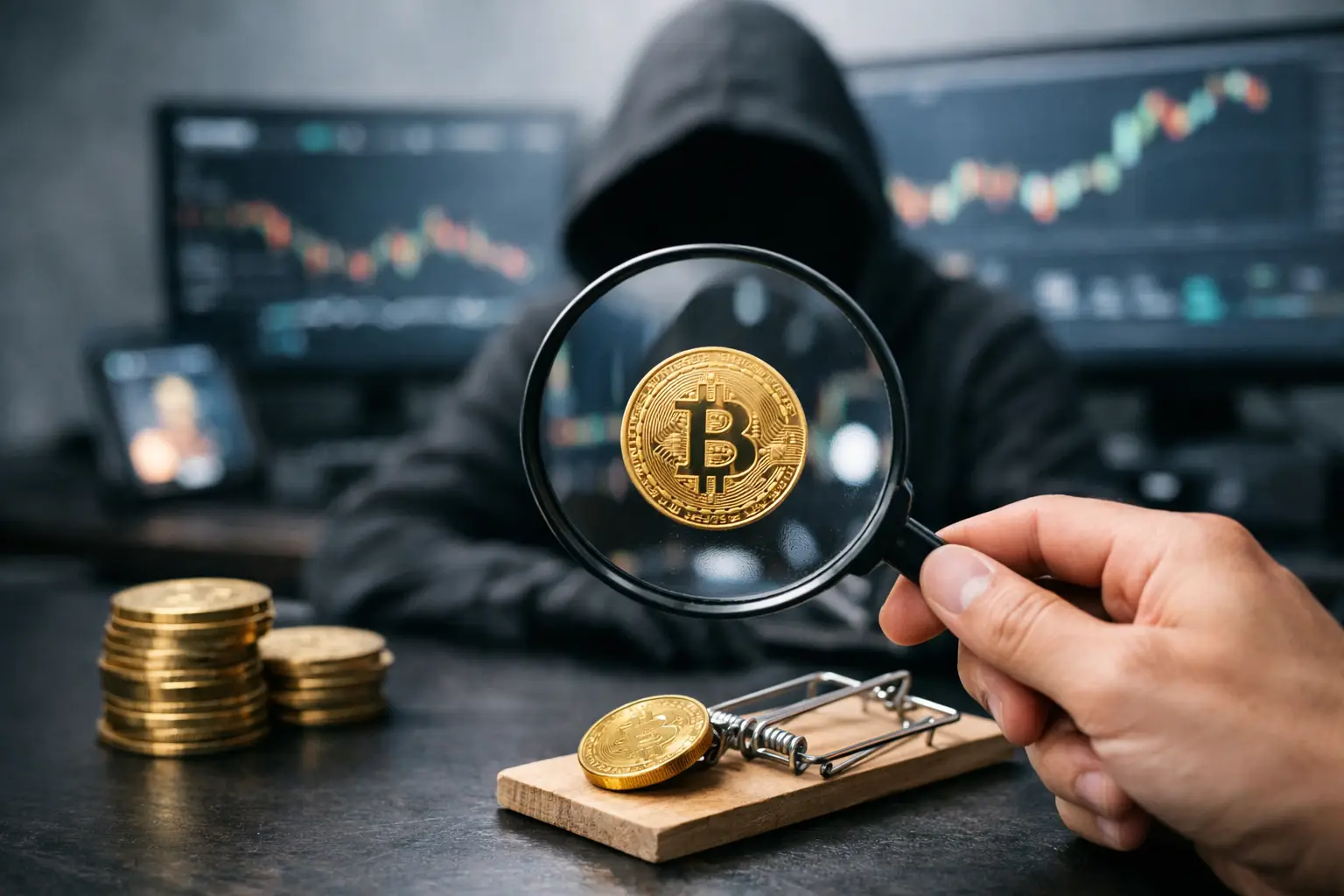
A convincing crypto scam rarely begins with a stranger in a dark corner of the internet. It often arrives as a polite WhatsApp message, a helpful-looking advert, or someone claiming to be customer support. Knowing the best signs of crypto scams gives you time to pause before money, or private wallet information, leaves your control.
For anyone building confidence with Bitcoin or other digital assets, this is not about becoming suspicious of everything. It is about learning a few calm, reliable rules. Real opportunities can wait. A genuine company will not punish you for asking questions. And no legitimate person needs your recovery phrase.
The best signs of crypto scams begin with pressure
Scammers want you to act before you have time to think, check, or speak to somebody you trust. Pressure is therefore one of the clearest warning signs, whatever form the scam takes.
1. You are told to act immediately
Messages such as “your account will be closed today”, “this offer ends in ten minutes”, or “buy now before the price explodes” are designed to trigger fear or excitement. Crypto markets move quickly, but you do not have to.
Take a break, especially if a decision involves a transfer of money or a new wallet. A good rule is to wait until the next day before making any unexpected crypto payment. If the offer disappears, that has saved you a problem rather than cost you an opportunity.
2. They promise guaranteed returns
No investment in crypto can honestly promise a fixed profit, a risk-free income, or a certain doubling of your money. Claims of guaranteed daily returns are particularly dangerous. They may be part of a fake trading platform or a scheme that uses early deposits to pay apparent profits to earlier users.
Bitcoin and other cryptoassets can rise and fall sharply. Anyone who minimises that risk, or says they have a secret system that cannot lose, is not giving balanced information.
3. A stranger contacts you first
Unexpected contact is not always fraudulent, but it deserves caution. It may begin with a wrong-number text, a friendly conversation on social media, or someone who appears to take a personal interest in you. Over time, the conversation turns to crypto, trading, or an investment platform they claim to use successfully.
This is sometimes called a relationship or romance investment scam. The person may be patient, kind and apparently knowledgeable. What matters is not how pleasant they seem, but whether their story can be independently checked. Do not send money to an investment suggested by someone you only know online.
Wallet safety: the sign that should stop you cold
A crypto wallet gives you control over your assets. That control comes with one private piece of information: your recovery phrase, sometimes called a seed phrase. It is usually a list of 12 or 24 words.
4. They ask for your recovery phrase or private key
This is one of the best signs of crypto scams because the rule is so clear: never share it. Not with support staff, a friend, a trading expert, or a website claiming it must “verify” or “repair” your wallet.
Anyone with those words can take the assets in that wallet. A legitimate wallet provider will not ask for them. Keep the phrase offline, written down carefully and stored somewhere private. Do not photograph it, email it to yourself, or type it into a form sent by somebody else.
5. A website asks you to connect your wallet without a clear reason
Some genuine crypto services ask you to connect a wallet, but beginners should treat every connection as a decision with consequences. A fake site can look remarkably polished and may use a web address that differs from the real one by a single letter.
Before connecting, check the address slowly. Do not follow a link from a message, advert, or pop-up. Find the official site yourself, and avoid signing transactions you do not understand. If a screen uses confusing technical language while urging you to approve, close it and seek independent guidance.
6. They tell you to send crypto to “verify” your account
There is no normal reason to send Bitcoin or another coin to an address simply to prove you own it, activate an account, release a prize, or receive a larger amount back. The familiar promise is: send £500 and we will return £1,000. Once sent, the money is usually gone.
Crypto transfers are generally difficult to reverse. That is why a small test payment is not a safe answer when the entire arrangement feels doubtful. The safer choice is not to send it at all.
Look beyond the polished appearance
A professional logo, a smart-looking dashboard and glowing testimonials can all be copied. Scammers know that people rightly want reassurance, so they create the appearance of a well-established business.
7. The platform shows profits, but makes withdrawals difficult
A fake investment platform may let you watch your balance rise each day. It may even allow one small withdrawal to build trust. Problems start when you try to take out a meaningful sum. Suddenly there is a tax, an account upgrade fee, a security charge, or a requirement to deposit more funds first.
Do not pay a fee to release your own money. A legitimate provider explains charges clearly in advance and deducts applicable fees from the transaction where appropriate. Repeated demands for extra deposits are a serious red flag.
8. The company is hard to verify
Search for more than reviews, as testimonials can be invented or copied. Check whether the business has a clear legal name, real contact details, named people, and a history that makes sense. Be wary if every positive comment uses similar wording or if the only way to contact the firm is through Telegram, WhatsApp, or direct messages.
A company can be real yet still unsuitable for you, so verification is only the first step. You should also understand how it holds your money, what fees apply, and whether you can withdraw without asking an individual for permission.
9. They use a celebrity, expert, or government identity
Videos and adverts featuring famous people can be altered with artificial intelligence. A scammer may also pretend to be a tax authority, bank employee, police officer, or crypto exchange representative. The name may be genuine while the message is not.
End the call or message and contact the organisation using details you find independently. Do not use the telephone number, link, or QR code provided by the person who contacted you.
Small checks prevent expensive mistakes
You do not need deep technical knowledge to make safer decisions. The aim is to add a short checking routine whenever something unexpected appears.
10. The message contains odd details or copied language
Poor spelling alone does not prove a scam. Plenty of honest people make mistakes, and fraudsters can now write convincing messages. Still, look for a combination of warning signs: an unfamiliar sender address, vague greetings, strange urgency, a link that does not match the organisation, or language that feels copied and impersonal.
Treat a message about account security with particular care. Rather than clicking, open the provider’s official app or type its web address into your browser yourself.
11. They ask you to install remote-access software
A caller may say they need to fix your computer, help with a wallet, or guide you through a withdrawal. They then ask you to install software that lets them see or control your screen. This can expose passwords, banking information and wallet details.
Never grant remote access to an unsolicited caller. Hang up, switch off the device if necessary, and ask a trusted person for help before doing anything else.
12. You feel embarrassed, confused, or unable to tell anyone
Scammers often encourage secrecy. They may say your bank will not understand crypto, that family members will talk you out of a special opportunity, or that support must be kept private for security. That is manipulation, not professional service.
Feeling confused does not mean you have failed. It means it is time to stop and get a second opinion. Speak to a family member, a trusted friend, or an independent adviser before moving funds. Learning the basics slowly can also make suspicious claims easier to spot. Simply Learn Crypto’s Free First Lesson is designed to explain the foundations in plain English, without the pressure to trade or act quickly.
If you think you have been targeted
Stop communicating and do not send another payment, even if you are told it is needed to recover earlier losses. Take screenshots of messages, wallet addresses, usernames and transaction details. Contact your bank promptly if you paid from a bank account or card, and report the matter through the appropriate fraud reporting service in your country.
If you shared a recovery phrase, move any remaining assets to a new wallet created with a completely new phrase, if you can do so safely. Do not accept help from people who approach you offering to recover lost crypto for a fee. Recovery scams often target people who have already been hurt once.
The most useful habit is wonderfully simple: pause before every unexpected crypto request. A few quiet minutes spent checking can protect savings that took years to build.
This article is shared for entertainment and educational purposes only. It is not financial advice. Crypto investments involve risk, and past performance is not a guide to future results. Always do your own research or speak to a qualified financial adviser before making any investment decisions.
