

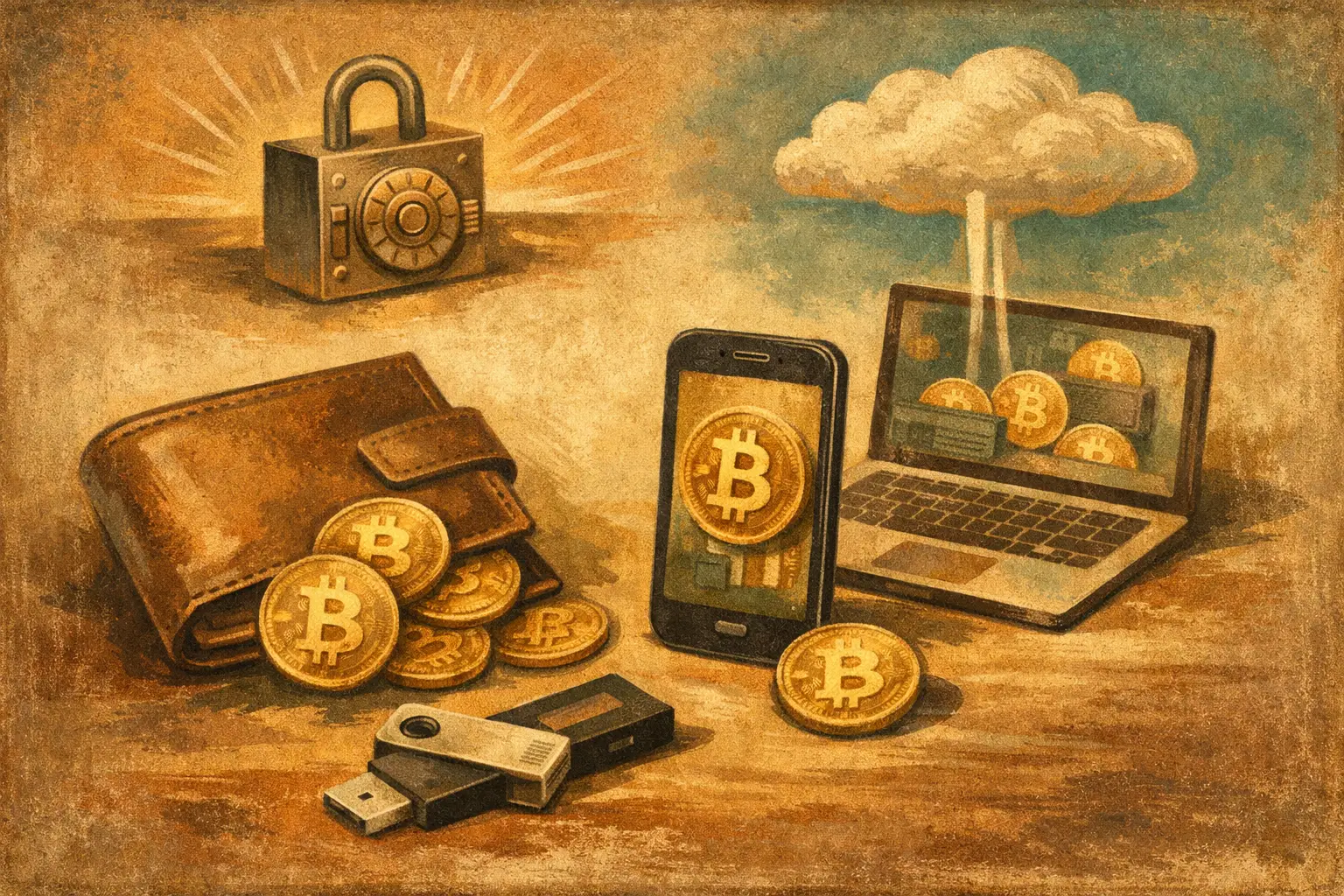
A lot of people buy a small amount of Bitcoin first and only then ask the question that really matters – where is it actually being kept? That is why bitcoin wallet types explained clearly can save you stress, mistakes and sleepless nights later on.
If you are new to crypto, the word wallet can be misleading. A Bitcoin wallet does not hold physical coins in the way your leather wallet holds cash. What it really does is store the keys that let you access and manage your Bitcoin on the blockchain. Once that clicks, the different wallet types start to make much more sense.
Bitcoin Wallet Types Explained Simply
Why understanding wallet types matters
For beginners, wallets can sound more technical than they need to. But this is not just a tech topic. It is really about control, convenience and safety.
Some wallets are easy to use but connected to the internet, which makes them more convenient and also more exposed. Others are far more secure for long-term holding, but they take a little more care to set up and manage. Neither is always right or wrong. It depends on how much Bitcoin you own, how often you use it and how comfortable you are taking responsibility for it yourself.
A good way to think about wallet choice is this: are you mainly buying Bitcoin to learn, to hold for years, or to spend and move around occasionally? Your answer usually points you towards the right type of wallet.
The two big groups: hot wallets and cold wallets
The simplest way to understand bitcoin wallet types explained is to start with the two main categories: hot wallets and cold wallets.
Hot wallets
A hot wallet is connected to the internet. This includes mobile apps, desktop wallets and web-based wallets. Hot wallets are popular because they are quick to access and usually easy for beginners to use.
If you want to check your balance on your phone, send Bitcoin quickly or get started with a small amount, a hot wallet often feels more comfortable. The trade-off is that an internet-connected wallet has a larger attack surface. If your phone, laptop or online account is compromised, your Bitcoin may be at risk.
That does not mean hot wallets are unsafe by default. It means they require sensible security habits, such as strong passwords, two-factor authentication and care around scams or fake apps.
Cold wallets
A cold wallet is not connected to the internet in normal day-to-day use. This makes it much harder for hackers to access remotely. Cold wallets are often used for larger amounts of Bitcoin or for long-term holding.
The downside is convenience. Cold storage is excellent for security, but not ideal if you want to move funds regularly. It also puts more responsibility on you to store backup information safely and avoid losing access.
For many people over 45, this is where a calm, practical approach helps. You do not need the most advanced setup on day one. You need a setup you understand and can manage confidently.
Custodial vs non-custodial wallets
There is another distinction that matters just as much as hot versus cold.
Custodial wallets
With a custodial wallet, another company holds your private keys for you. This is common on crypto exchanges. In plain English, they are looking after your Bitcoin on your behalf, a bit like a platform holding your account.
This can feel easier for beginners because there is less to manage. If you forget a password, there may be account recovery options. The experience can feel familiar, more like online banking.
But there is a trade-off. If someone else controls the keys, you are trusting them with access. If the platform freezes withdrawals, suffers a serious problem or your account is compromised, you may not have full control when you need it most.
Non-custodial wallets
With a non-custodial wallet, you hold the private keys yourself. That means you control your Bitcoin directly. No company can move it for you or block access in the normal course of use.
This is closer to the original idea of Bitcoin – personal ownership and control. But it also means responsibility. If you lose your recovery phrase and something happens to your device, there may be no customer service desk that can restore access for you.
For long-term holders, non-custodial wallets often make the most sense. For complete beginners, the best route is often learning how they work before moving meaningful sums.
The main wallet types in plain English
Exchange wallet
This is the wallet you use when your Bitcoin is left on an exchange after buying it. It is usually the easiest starting point because everything happens in one place.
For small amounts and short-term use, many beginners start here. But it is best thought of as a temporary holding place rather than your final storage solution. Keeping larger amounts on an exchange for long periods adds counterparty risk because you are relying on that company to protect your funds and grant access when needed.
Mobile wallet
A mobile wallet is an app on your smartphone. It is one of the most user-friendly options and works well for smaller amounts, learning and occasional transactions.
For many people, this is the easiest non-custodial step. You install the app, back up your recovery phrase and begin to understand what self-custody means. The concern is that phones can be lost, stolen or infected with malicious software, so security habits matter.
Desktop wallet
A desktop wallet is installed on your computer. It can give you more control and a larger screen, which some people prefer when they are learning.
That said, if your computer habits are not especially security-conscious, it can still be vulnerable. A desktop wallet is not automatically safer than a mobile wallet. It depends on how well the device is maintained and protected.
Web wallet
A web wallet runs in your browser. These are convenient because you can access them from different devices, but they generally involve more online exposure.
For beginners, convenience can be appealing. Still, for serious long-term storage, web wallets are rarely the first choice because they rely heavily on the security of the service and your online behaviour.
Hardware wallet
A hardware wallet is a small physical device designed to store your private keys offline. This is one of the best-known forms of cold storage.
For long-term holders, a hardware wallet is often the sensible middle ground between strong security and practical usability. You still need to keep your recovery phrase safe, and you need to learn how to use the device properly. But once set up correctly, it can be an excellent option for those who want more control without being highly technical.
Paper wallet
A paper wallet usually means printing or writing down key information on paper. Years ago, this was discussed more often. Today, it is generally seen as less practical and easier to get wrong than other methods.
Paper can be lost, damaged, photographed or misunderstood by the person using it. For most beginners, especially those wanting a simple and reliable arrangement, there are better options.
Which wallet type suits which person?
If you are just starting with a modest amount of Bitcoin, a reputable mobile wallet or even a temporary exchange wallet may be enough while you learn. The goal at that stage is not perfection. It is understanding.
If you expect to hold Bitcoin over the long term, especially as part of broader wealth preservation thinking, a non-custodial setup becomes more attractive. For many people, that leads naturally to a hardware wallet once they are ready.
If you want convenience above all else, custodial options feel easier. If you value control and independence, non-custodial options are usually the better fit. Neither decision should be rushed.
One common mistake is choosing a setup that is theoretically very secure but practically confusing. A wallet is only useful if you can use it properly, recover it if needed and explain it clearly to a spouse or family member if something happens to you.
Safety points that matter more than wallet jargon
Whatever wallet you choose, a few habits matter more than clever terminology. Your recovery phrase should be written down carefully and stored somewhere safe and private. It should never be typed into random websites, photographed casually or shared with anyone claiming to help.
It is also wise to start small. Send a test transaction before moving larger amounts. Take your time reading each screen. Most costly errors in crypto happen through haste, panic or trust in the wrong person.
For older beginners, there is another practical layer to think about: legacy. If you hold Bitcoin yourself, would a trusted family member know what to do if you were no longer able to manage it? Good wallet planning is not only about security today. It is also about clarity for the future.
A calm way to choose your first wallet
If all of this still feels a little new, that is completely normal. The best first step is not chasing the most advanced setup. It is choosing something simple enough to understand and safe enough for your current stage.
Start by asking three questions. How much Bitcoin will I hold? How often will I use it? Am I ready to take full responsibility for my own backup phrase? Those answers usually narrow the field quickly.
Once you understand the difference between hot and cold, and between custodial and non-custodial, the fog starts to lift. You stop seeing wallets as mysterious crypto tools and start seeing them as practical storage choices with clear trade-offs.
That is often the turning point. Confidence in Bitcoin rarely comes from buying more. It usually comes from understanding where it is kept, who controls it and why your setup matches your needs.
