

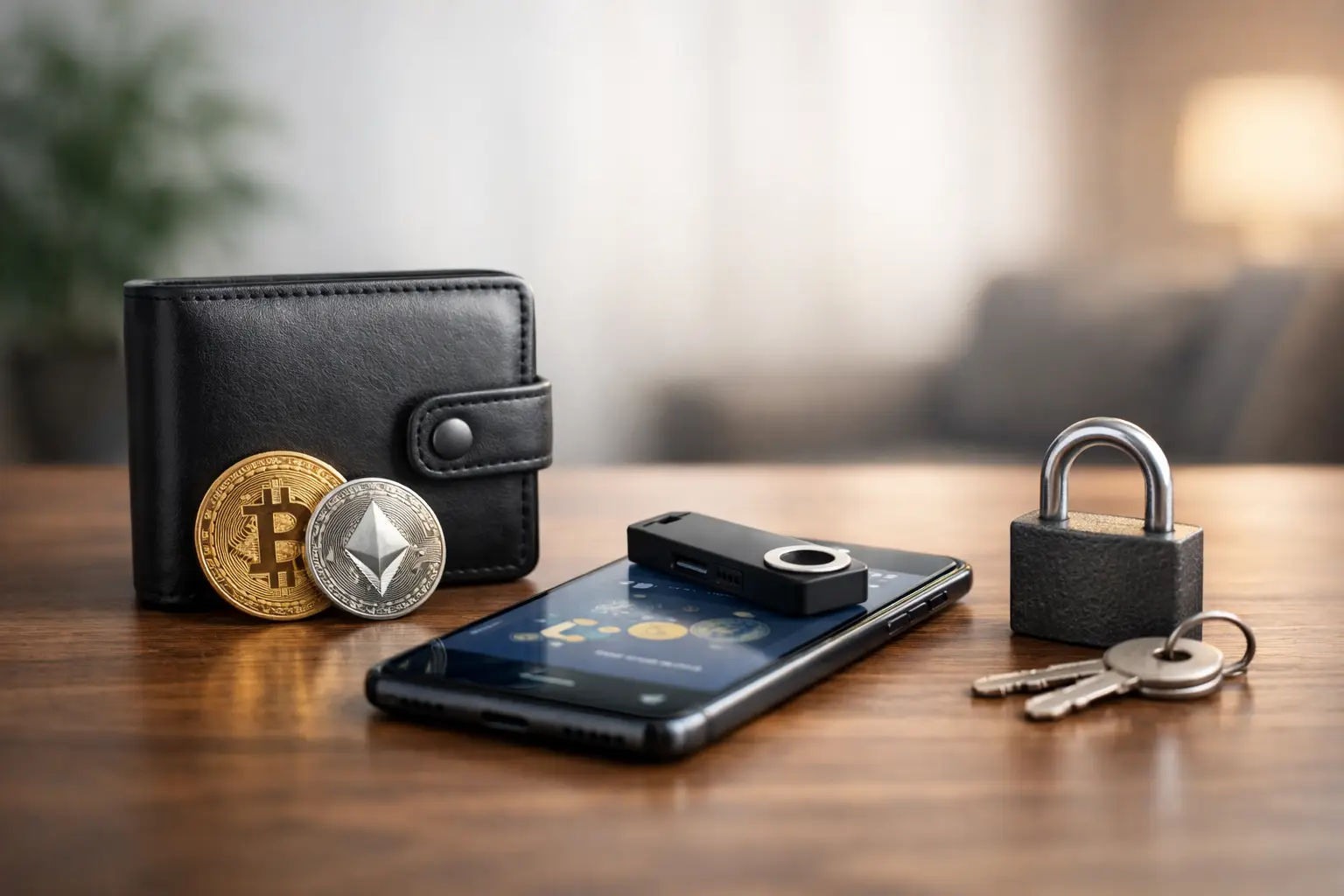
A crypto wallet is not a wallet in the usual sense. It does not physically hold coins in the way a leather wallet holds cash. Instead, crypto wallets hold the keys that prove you can access and move your Bitcoin or other digital assets.
That distinction may sound small, but it is the foundation of crypto safety. Once you understand what a wallet does, the decisions around apps, devices, passwords and backups become far less intimidating.
For many people approaching crypto as part of long-term savings, family planning or simple curiosity, the goal is not to become highly technical. It is to know where your assets are held, who controls them, and how to avoid preventable mistakes.
What crypto wallets actually do
Your cryptocurrency exists on a blockchain, which is a shared digital record of transactions. A wallet gives you a way to interact with that record. It creates a public address, which is like an account number that people can use to send crypto to you, and it protects your private key.
Your private key is the part that matters most. It is the secret proof that allows a transaction to be authorised. Anyone with that key can control the assets connected to it. This is why crypto ownership brings a little more personal responsibility than holding money in a traditional bank account.
Most modern wallets do not show you a long private key. Instead, when you set one up, they provide a recovery phrase, often made up of 12 or 24 ordinary words. This phrase can restore your wallet if your phone is lost, your computer fails or the wallet app is deleted.
Treat that recovery phrase as you would the keys to a safe containing your savings. Do not share it with anyone. Do not type it into a website. Do not save it in an email, cloud document or a photograph on your phone.
The two main types of crypto wallets
The first broad choice is between a hot wallet and a cold wallet. Neither is automatically right for every person. The sensible choice depends on how much you hold, how often you need access, and how comfortable you are managing your own security.
Hot wallets: convenient for smaller amounts
A hot wallet is connected to the internet. It may be a mobile app, a desktop application or a wallet provided through a crypto exchange. These wallets are convenient because they make it easy to check a balance, receive funds or make a transaction.
For someone starting with a modest amount while they learn, a reputable hot wallet can be a reasonable place to begin. However, its internet connection means there is more exposure to phishing attempts, malicious apps and compromised devices.
A hot wallet is best thought of as the spending money in your purse or wallet. Keep only an amount you would be comfortable having readily available. It should not automatically become the long-term home for a substantial holding.
Cold wallets: stronger protection for long-term holding
A cold wallet keeps the key away from an internet-connected device. The most familiar form is a small hardware wallet that stores the key securely and asks you to approve transactions on the device itself.
For people holding crypto for years rather than trading regularly, this can provide valuable peace of mind. Even if your computer picks up malware, a transaction still needs to be checked and confirmed on the hardware wallet.
There are trade-offs. You need to buy the device from a trustworthy source, keep it safely stored, and carefully record the recovery phrase during setup. A hardware wallet is not a magic shield if somebody tricks you into approving a fraudulent transaction or persuades you to reveal your recovery words.
Exchange account or personal wallet?
This is one of the most useful questions for a beginner. If you buy crypto through an exchange, the exchange may hold it for you. This is called custodial storage. It can feel familiar because the company manages much of the technical side, including access recovery procedures.
The trade-off is control. You are trusting that company to safeguard the assets and continue operating properly. You may also face account restrictions, identity checks or delays if the platform detects unusual activity.
A personal wallet is non-custodial. You hold the recovery phrase, so you have direct control. There is no company that can reset it for you if you lose the phrase. For some, that responsibility feels empowering. For others, especially at the beginning, it can feel like too much to manage alone.
There is no prize for rushing into self-custody. A good approach is to learn the basics, begin with a small amount and practise receiving and sending a tiny test transaction. Calm confidence grows through simple, careful experience rather than trying to do everything at once.
How to choose a wallet without getting overwhelmed
Start with your purpose. Are you buying a small amount of Bitcoin to understand how it works? Are you planning to hold for several years? Do you expect to use different digital assets, or are you focused on one established asset?
Then consider how you will use it. A mobile wallet may suit someone who values convenience and is careful with phone security. A hardware wallet may be more suitable for a long-term holder who wants to reduce online exposure. Some people use both: a small hot wallet for learning and a cold wallet for longer-term storage.
Look for a wallet with a clear setup process, a good reputation and straightforward instructions. Avoid choosing purely because a social-media advert claims it is the newest or most profitable option. A wallet does not make an investment safer or more valuable. Its job is to help you store and control access to the assets you already own.
If you are still finding the language confusing, start with the Free First Lesson before making any decisions. Understanding a few core ideas, such as private keys and recovery phrases, can prevent many of the mistakes that catch newcomers out.
The safety habits that matter most
The strongest security is usually not complicated. It is a set of calm, repeatable habits followed every time.
First, write your recovery phrase down accurately during setup and check every word. Store it offline in a secure, private place. Some people keep a second copy in a separate secure location in case of fire or flood. Think carefully about who would need to find it if you became unable to manage your affairs, but do not leave it openly accessible.
Second, never share your recovery phrase, private key, password or security code. Genuine wallet providers, exchanges, banks and support teams will not ask for your recovery words. Anyone who does is attempting to gain control of your crypto.
Third, be suspicious of urgency. Scammers often say your account is at risk, an investment opportunity is about to disappear, or a helpful technician needs remote access to your computer. Pause. Close the message. Use only official contact details that you find independently.
Fourth, check addresses character by character when sending crypto. Transactions cannot normally be reversed. For a larger transfer, send a small test amount first and wait for it to arrive before sending the remainder. It may feel slow, but it is a sensible habit.
Finally, protect the devices around your wallet. Use a strong unique password, enable two-factor authentication where available, install updates, and do not allow strangers remote access to your phone or computer.
Planning for a partner or family
Crypto can create a practical legacy question. If you alone know where the wallet is, how to access it and where the recovery phrase is stored, your family may struggle to deal with it later.
This does not mean sharing your recovery phrase casually. It means making a considered plan. You might document what assets exist, where relevant devices are kept and what professional help or trusted person should be contacted. The recovery phrase itself should remain protected, but your existence of a plan should not be a secret.
This is especially worth considering for couples. One partner should not be left entirely in the dark because the other is more interested in technology. A short, calm conversation now is kinder than a confusing problem later.
Crypto wallets are simply tools. Used carelessly, they can cause stress. Used with patience and a few sensible rules, they can give you clear personal control over digital assets. Take your time, practise with small amounts, and choose security habits you can realistically maintain for years.
This article is shared for entertainment and educational purposes only. It is not financial advice. Crypto investments involve risk, and past performance is not a guide to future results. Always do your own research or speak to a qualified financial advisor before making any investment decisions.
