

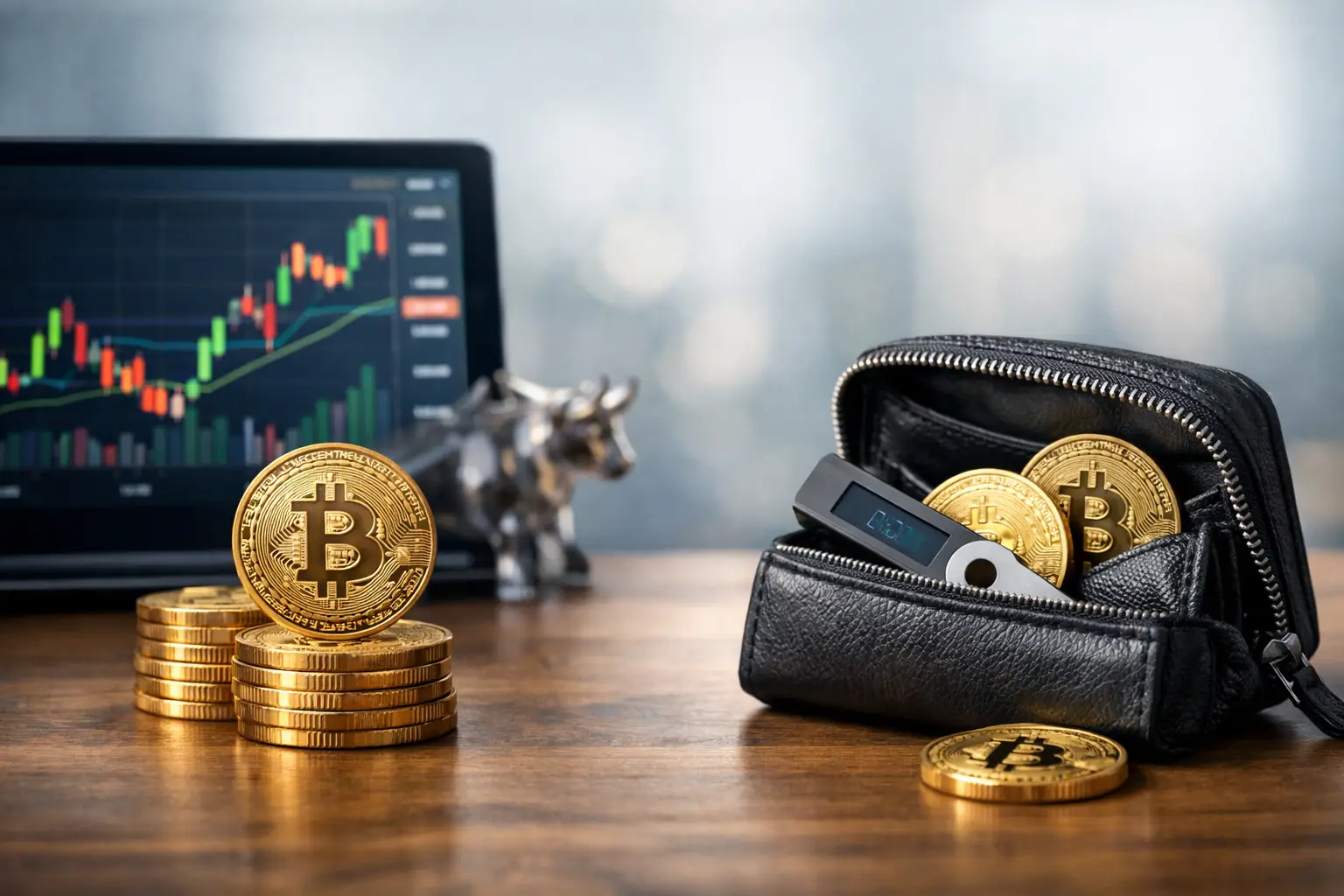
A bitcoin ETF vs bitcoin wallet comparison is really about one important question: do you want an investment that follows Bitcoin’s price, or do you want to hold Bitcoin yourself? The two can sound similar, especially when headlines simply say that someone has “bought Bitcoin”. Yet the experience, responsibilities and risks are quite different.
For anyone thinking carefully about retirement savings, family wealth or long-term financial security, this distinction matters. One route may feel more familiar because it sits alongside traditional investments. The other gives you direct ownership, but asks you to learn a few safety basics first.
Bitcoin ETF vs Bitcoin wallet: the simple difference
A Bitcoin ETF is a fund traded through a stockbroker or investment platform. Its value is designed to track the price of Bitcoin. You buy shares in the fund, rather than buying individual Bitcoin yourself.
A Bitcoin wallet is where you hold actual Bitcoin. More precisely, it protects the private keys that prove you can move and spend your Bitcoin. If you buy Bitcoin and send it to your own wallet, you are in direct control of it.
Think of an ETF as owning an investment product that follows the gold price. A wallet is closer to holding gold yourself in a secure safe. Both can give you exposure to the same underlying asset, but ownership and responsibility are not the same.
What you own in each case
With a Bitcoin ETF, you own shares in a fund. The fund provider and its appointed custodians deal with buying, storing and safeguarding the Bitcoin behind the scenes. You do not receive a Bitcoin address, and you cannot send part of your holding to a family member or use it to pay someone.
With a wallet, you own Bitcoin that can be moved on the Bitcoin network. You can send it to another wallet anywhere in the world, at any time, provided you have access to your keys and follow the network’s rules. No fund manager stands between you and the asset.
This direct ownership is often described as self-custody. It can feel empowering, but it is not automatically better for everyone. Control comes with responsibility. If you lose access to your wallet and have not stored your recovery phrase safely, there may be no customer service team able to restore it.
Why some beginners prefer a Bitcoin ETF
Many people over 45 prefer an ETF because the process may resemble investments they already understand. You might buy and sell through an established brokerage account, see the holding alongside funds and shares, and receive familiar statements for record-keeping.
The security burden is also lighter. You do not need to create a recovery phrase, choose a hardware wallet or worry about sending Bitcoin to the wrong address. For a person who wants price exposure but has no interest in using Bitcoin directly, this can be reassuring.
An ETF may also make it simpler to include Bitcoin as a small part of a wider portfolio. You can decide how much exposure you are comfortable with, rather than treating Bitcoin as an all-or-nothing decision. That said, the price of Bitcoin can move sharply, and owning it through an ETF does not remove that market risk.
There are costs to consider. ETFs usually charge an annual management fee, often shown as a percentage. Your broker may also charge dealing, platform or foreign-exchange fees. These costs can seem small in a single year but deserve attention if you intend to hold for a long time.
Availability is another practical point. Bitcoin exchange-traded products are regulated differently from country to country. What is available to a US investor may not be available to a retail investor in the UK or Europe, and the rules can change. Before acting, check what your own regulated platform offers, what you are actually buying and how it is taxed in your country.
Why some people choose a Bitcoin wallet
A wallet is for people who want direct possession of Bitcoin. That may matter if you value independence from a fund provider, want the ability to transfer Bitcoin yourself, or simply want to understand the technology rather than only its price.
There are different wallet types. A mobile wallet can be convenient for a small amount, much like carrying spending money. A hardware wallet is a small physical device designed to keep private keys offline and is often used for larger, long-term holdings. Neither is magic protection: safe habits are what make a wallet safer.
The most important item is usually the recovery phrase, often a list of 12 or 24 words. It is the backup that can restore access to your Bitcoin if your mobile phone or hardware device is lost, damaged or replaced. Anyone who sees those words can potentially take your Bitcoin. They should never be photographed, typed into a website, shared with a caller or handed to a supposed support agent.
For many beginners, the worry is not the technology itself but making an irreversible mistake. That is a sensible concern. Bitcoin transactions generally cannot be cancelled once confirmed. A calm approach is to practise with a very small amount, check every address carefully and never rush because of a message, phone call or online warning.
Security: convenience versus control
The central trade-off is straightforward. An ETF gives you more convenience and places custody with professionals. A wallet gives you more control and places custody with you.
Neither route is free from risk. With an ETF, risks can include market volatility, provider fees, changes to product terms and reliance on your broker and fund structure. With a wallet, risks include phishing scams, lost recovery phrases, poor backups and mistakes made under pressure.
If you choose a wallet, make a simple safety plan before buying a meaningful amount. Keep the recovery phrase offline, stored privately in more than one secure location if appropriate. Tell no one the details of your holdings. Be especially cautious of anyone contacting you unexpectedly about crypto, even if they claim to be from a well-known company.
If you choose an ETF, use a reputable, regulated platform and protect your account with a strong unique password and two-factor authentication. Read the fund documents so you understand the fees, where it is listed and whether it tracks Bitcoin directly or uses a different structure.
Estate planning deserves early thought
Bitcoin can create an awkward problem for families if plans are not made in advance. A wallet that only one person knows how to access may become inaccessible after illness or death. An ETF held through a conventional investment account may be easier for executors to identify, but your wider estate plan still needs to be clear.
This does not mean sharing passwords or recovery phrases casually. It means considering how a trusted person would know that assets exist and how they could receive lawful, appropriate guidance if something happened to you. For a self-custody wallet, careful written instructions kept separately from the recovery phrase can be helpful. Professional estate planning advice may be worthwhile where the amounts involved are significant.
Which option may suit you?
A Bitcoin ETF may suit you if you want a familiar investment route, prefer not to manage private keys and mainly see Bitcoin as a small, long-term portfolio holding. It may also suit someone who values simple reporting and does not intend to send or use Bitcoin personally.
A Bitcoin wallet may suit you if direct ownership matters to you, you are prepared to learn the safety steps and you want the freedom to hold and transfer Bitcoin without relying on a fund. It may be particularly appealing to those who believe that personal control is part of Bitcoin’s purpose.
Some people eventually use both. They may hold a modest ETF position for simplicity while learning self-custody slowly with a small wallet balance. There is no prize for moving quickly, and there is no shame in choosing the option that you understand best.
Before choosing either route, give yourself time to learn the basics of Bitcoin, wallets, scams and safe storage. Simply Learn Crypto’s Free First Lesson is designed to help beginners build that confidence in plain English, without pressure or technical overload.
The most useful next step is not to chase a price movement. It is to choose the level of ownership and responsibility that lets you sleep comfortably at night.
This article is shared for entertainment and educational purposes only. It is not financial advice. Crypto investments involve risk, and past performance is not a guide to future results. Always do your own research or speak to a qualified financial adviser before making any investment decisions.
